
If you have ever felt like the rules around peptide therapy keep shifting under your feet, you are not imagining it. This summer, those rules are getting a closer look. An FDA peptide review is scheduled for July 23–24, 2026, and it could shape how some of the most-studied peptides in regenerative and longevity medicine are accessed going forward. Here is what is actually happening, what it means for medically guided care, and why none of it changes how we do things at Momentum — because precision and supervision were never optional to begin with.
Table of Contents
What the FDA Peptide Review Actually Is
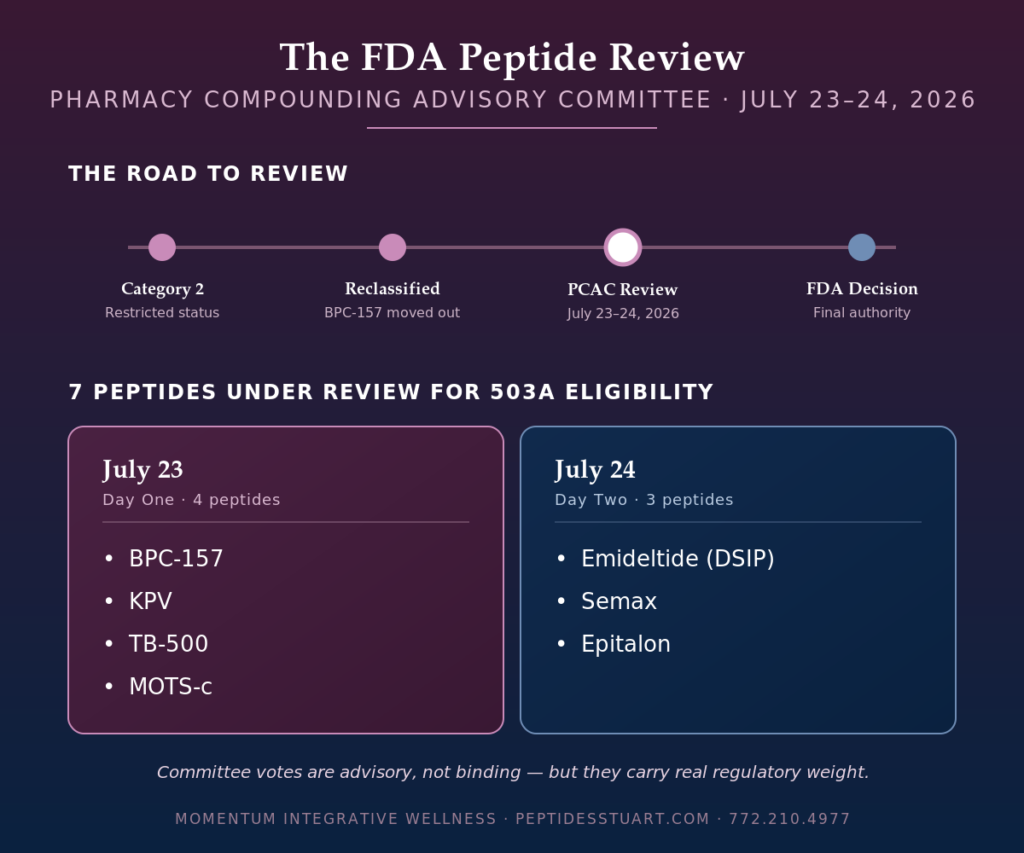
On July 23 and 24, 2026, the FDA’s Pharmacy Compounding Advisory Committee (PCAC) will meet to review seven peptides for what is known as 503A compounding eligibility. In plain terms, the committee is weighing whether these peptides can be prepared by compounding pharmacies for an individual patient under a licensed prescriber’s order.
The review is split across two days. Here is the lineup:
- July 23: BPC-157, KPV, TB-500, and MOTS-c
- July 24: Emideltide (also called DSIP), Semax, and Epitalon
If a few of those names look familiar, that is because several — BPC-157, TB-500, and MOTS-c — are peptides we discuss with clients regularly for healing, recovery, and mitochondrial support. This is not fringe science being examined. It is the same evidence-informed category that thoughtful clinics have been using carefully for years.
Why BPC-157 Moving Out of Category 2 Matters
Ahead of the meeting, the FDA moved BPC-157 out of its more restrictive Category 2 classification. That shift is what cleared the path for the committee to formally review it. It is a meaningful signal — not a final verdict, but a sign that the agency is willing to take a closer, evidence-based look rather than keep the door shut.
This is the part worth slowing down on. A reclassification is procedural. It does not mean a peptide is suddenly “approved,” and it does not mean anything purchased online from an unverified source is safe or appropriate. It simply means the conversation is moving forward through the proper channels — which is exactly where these decisions belong.
Advisory Votes Are Not Binding — But They Carry Weight
Here is a nuance that often gets lost in the headlines. The Pharmacy Compounding Advisory Committee is a panel of outside scientific and clinical experts. They review the evidence, hear public comment, and make recommendations to the FDA. Their votes are advisory, not binding — the FDA retains final authority.
That said, these recommendations carry real regulatory weight. The agency listens closely to where the committee lands. So while July’s meeting will not flip a switch overnight, it is a genuine inflection point for how compounded peptides may be accessed in the months ahead. We will be watching it closely so our clients do not have to.
What This Means for Peptide Therapy in Stuart, FL
For the people we work with, the practical takeaway is reassuring: nothing about good medicine changes based on a regulatory headline. At Momentum, peptides have always been handled one way — clinically, individually, and under medical supervision.
The FDA review is, in many ways, a public catch-up to a standard we already hold ourselves to. Consider the difference:
- Clinical-grade sourcing — not gray-market “research only” vials of unknown origin.
- Evaluation by a licensed medical prescriber — your history, labs, and goals come first.
- Individualized protocols — dosing built around your biology, not a one-size-fits-all template from a forum.
- Ongoing monitoring — we measure and adjust, rather than guess and hope.
Peptide therapy isn’t about trends or quick fixes — it’s about precision. More than 7,000 peptides exist in the human body, acting as messengers that tell your cells what to do. The goal is never to chase a buzzword. It is to support your biology with the right message, at the right time, in the right hands.
The Risk of DIY in a Shifting Landscape
Whenever access feels uncertain, two reactions tend to spike: people either panic-buy from questionable sources, or they give up on something that could genuinely help them. Both are avoidable. A regulatory review is a reason to lean further into supervised care, not away from it.
You deserve more than guesswork — and more than a stranger’s protocol screenshot. Working with a clinical team means your peptide plan is sourced responsibly, prescribed appropriately, and adjusted as your body responds. That is the part the internet cannot give you.
Frequently Asked Questions
Q: What is the FDA peptide review happening in July 2026?
A: It is a Pharmacy Compounding Advisory Committee meeting on July 23–24, 2026, reviewing seven peptides — including BPC-157, TB-500, and MOTS-c — for 503A compounding eligibility. The committee makes recommendations to the FDA, which holds final authority.
Q: Does this mean peptides like BPC-157 are now FDA-approved?
A: No. BPC-157 was moved out of the more restrictive Category 2 classification so it could be formally reviewed, but a reclassification is procedural, not an approval. The committee’s upcoming vote is advisory.
Q: Will this change how Momentum offers peptide therapy?
A: No. Our peptides have always been clinical-grade, prescribed by a licensed medical provider, and individualized with ongoing monitoring. The review reflects a standard we already practice.
Q: Are over-the-counter or online “research” peptides the same thing?
A: They are not. Products sold without a prescriber, labs, or quality assurance carry real risks. Medically guided peptide therapy is built around your biology and supervised every step of the way.
The Peptide Support Guide for Women
Peptides are your body’s messengers — and as they decline with age, stress, and hormonal shifts, so does how you feel. This printable guide breaks down, in plain language, how peptide therapy supports energy, sleep, metabolism, and hormones for women in midlife. This isn’t about chasing quick fixes — it’s about understanding what your body actually needs. Enter your email and we’ll send the guide straight to your inbox.
No spam — just science-backed support for your health. Unsubscribe anytime.
You’re in!
Your Peptide Support Guide for Women is ready — grab your copy below.
Download the Guide (PDF)Stay Ahead of the Curve — With a Team That Already Is
The July FDA peptide review is worth paying attention to, but it does not have to be something you navigate alone. The clinics worth trusting were already operating at this standard — clinical sourcing, real evaluation, individualized protocols, and measurement instead of guesswork. If you have been curious about peptides for healing, recovery, energy, or longevity, this is a good moment to ask your questions to people who can actually answer them.
Curious whether peptide therapy in Stuart, FL is right for you? Call 772.210.4977 or visit PeptidesStuart.com to schedule a consultation. We don’t guess. We measure. We optimize. And we walk with you every step of the way.
Medical services are provided by licensed healthcare professionals following appropriate clinical evaluation. This article is for educational purposes and is not medical advice. Sources: FDA Advisory Committee Calendar; AJMC; Lengea Law.