You started a GLP-1 expecting the medication to do the heavy lifting. And to be fair — it does a lot. It quiets the food noise, regulates appetite, and improves how your body signals satiety and blood sugar. But if you’ve ever wondered why some people on a GLP-1 weight loss strategy see dramatic body composition changes while others stall out at the same dose, the answer isn’t in the injection. It’s in everything that happens around it.
Your nutrition. Your protein intake. Your strength training. Your sleep. Your hydration. Your inflammation status. Your ability to preserve muscle while reducing body fat. These are the levers that actually determine whether you lose weight the right way — or lose weight in a way you’ll regret a year from now.
Table of Contents
Why a One-Size-Fits-All GLP-1 Weight Loss Strategy Doesn’t Work
A plan designed to maximize fat loss looks very different from a plan designed to build lean muscle and improve body composition. And the ideal approach varies depending on which medication you’re taking.
A GLP-1 protocol, a GLP-1/GIP protocol, and a triple agonist protocol each create different physiological effects — and each often requires a different nutritional and lifestyle strategy to support it.
This is where many patients get frustrated. They’re handed a prescription, told to “eat more protein,” and sent on their way with little guidance on how to actually optimize their results.
If your provider isn’t talking to you about:
- Body composition (not just the scale)
- Personalized protein targets
- Your inflammation status
- Strength training as part of the protocol
- How to tailor your nutrition to your specific medication and goals
…you may not be getting the full benefit of treatment.

The Day-to-Day Decisions That Make or Break Results
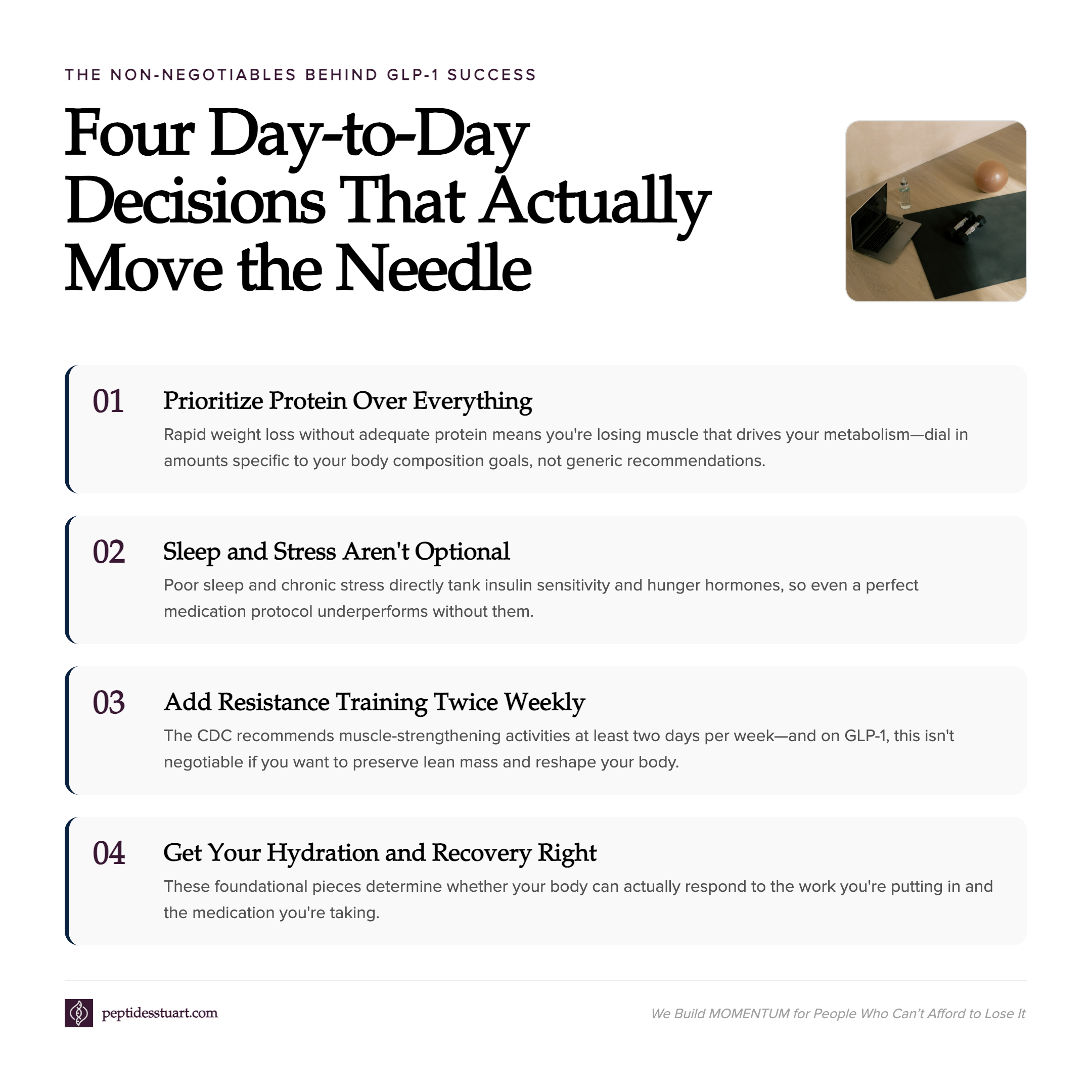
The medication may help regulate the signal — but you decide what to do with it. And the ancillary activities surrounding your protocol are what ultimately determine your outcome.
Protein and Muscle Preservation
Rapid weight loss without adequate protein and resistance training means you’re losing more than fat — you’re losing the muscle that drives your metabolism, your strength, and your long-term health. Protein targets need to be specific to your body composition goals, not a generic recommendation.
Sleep, Hydration, and Stress
These foundational pieces aren’t optional add-ons. Poor sleep and chronic stress directly impact insulin sensitivity, hunger hormones, and recovery. When these are out of alignment, even the most precise medication protocol underperforms.
Strength Training Over Cardio
Strength training is the single most underutilized tool in modern weight loss. It preserves lean mass, improves insulin sensitivity, and reshapes your body in a way the scale alone will never show. According to the CDC’s physical activity guidelines, adults should include muscle-strengthening activities at least two days per week — and for anyone on a GLP-1, that’s a non-negotiable.
When Progress Stalls, the Next Step Is Data
We don’t believe every patient needs an exhaustive panel of labs on day one. That approach drives up cost without driving up results.
But if you’ve increased your dose, stayed consistent, and progress has stalled? That’s often your body’s way of telling us it’s time to look deeper.
Markers like:
- Fasting insulin
- Inflammation markers
- Thyroid function
- Sex hormones
- Your omega-6 to omega-3 ratio
…can reveal exactly why your body is resisting further change. When we identify the true bottleneck, we can make strategic adjustments — rather than simply continuing to escalate medication.
This is the difference between guessing and optimizing. We don’t guess. We measure. We optimize. And we walk with you every step of the way.

Body Composition Enhancement — Not Just Weight Loss
At Momentum, our focus has always been body composition enhancement, not the number on the scale. Our goal is to help you:
- Reduce body fat
- Preserve or build lean muscle
- Improve metabolic health
- Create a strategy that supports long-term success and longevity
This matters because weight loss without muscle preservation is a setup for rebound weight gain, slower metabolism, and reduced strength as you age. A well-designed medical weight loss program should always prioritize what happens to your muscle as much as it prioritizes what happens to the scale.
The Peptide Support Guide for Women
Peptides are your body’s messengers — and as they decline with age, stress, and hormonal shifts, so does how you feel. This printable guide breaks down, in plain language, how peptide therapy supports energy, sleep, metabolism, and hormones for women in midlife. This isn’t about chasing quick fixes — it’s about understanding what your body actually needs. Enter your email and we’ll send the guide straight to your inbox.
No spam — just science-backed support for your health. Unsubscribe anytime.
You’re in!
Your Peptide Support Guide for Women is ready — grab your copy below.
Download the Guide (PDF)The Case for the Lowest Effective Dose
We also believe in using the lowest effective dose to achieve the desired result whenever possible. When the foundational pieces are in place — nutrition, training, sleep, labs — patients often experience better outcomes without unnecessarily escalating medication.
That approach not only supports better results, but also helps keep treatment more affordable over time. Higher doses mean higher costs, more potential side effects, and more dependence on the medication to do what your strategy should be doing.
Precision over protocol. Strategy over escalation.
Frequently Asked Questions
Q: Why am I not losing weight on my GLP-1 anymore?
A: Stalled progress is rarely about the medication failing. It's usually a sign that something in your foundation — protein, training, sleep, hormones, or inflammation — is acting as a bottleneck. The right next step is often data, not a dose increase.
Q: Do I really need labs to start a GLP-1 weight loss strategy?
A: Not necessarily on day one. We don't believe in over-testing every patient up front. But if you've been consistent and progress has stalled, targeted labs (fasting insulin, inflammation markers, thyroid, sex hormones) help us pinpoint exactly what to adjust.
Q: How much protein should I be eating on a GLP-1?
A: There's no universal answer — your target depends on your body composition, activity level, age, and which medication protocol you're on. Generic recommendations like "eat more protein" miss the precision your body actually needs.
Q: Will I regain the weight if I stop the medication?
A: That depends entirely on what you built during your time on it. Patients who used the medication as part of a body composition strategy — preserving muscle, dialing in nutrition, training consistently — are far better positioned for long-term maintenance than those who relied on the injection alone.
The Right Strategy Behind the Medication
Success on a GLP-1 doesn't come from the medication alone. It comes from having the right strategy behind it — one that's built around your body, your goals, and the specific protocol you're on.
If you've been doing the work and feel like your results have stalled, or if you're considering a GLP-1 and want a plan that's actually designed for you, we'd love to help you build it.
Call 772.210.4977 or visit PeptidesStuart.com to book your consultation. Appointments available Monday through Saturday.
Medical services are provided by licensed healthcare professionals following appropriate clinical evaluation.