
Peptides for Medical Weight Loss
A personalized medical weight loss program that works with your biology—not against it.
Struggling with weight despite doing “everything right” can be a sign of metabolic dysfunction or hormone imbalance—not personal failure. GLP-1 medications are now the first-line medical weight loss therapy, clinically proven to improve insulin resistance, regulate appetite, and support meaningful, sustainable fat loss.
Licensed Medical Oversight • HIPAA Compliant EHR & Secure Systems • Evidence-Informed, Test-Based Care • Certified Health Coaching • Personalized Clinical Protocols
By Appointment Only
Momentum Integrative Wellness by Bella Rose
2440 SE Federal Highway, Suite 600
Stuart, FL 34994
What if weight loss wasn’t about doing more—but about restoring what your metabolism was always meant to do?
At Momentum Integrative Wellness, we provide science-based, personalized treatment plans using peptides for medical weight loss—including GLP-1–based therapies like GLP1-S, GLP1-T, and GLP1-R.
Whether you’ve been stuck in cycles of dieting, insulin resistance, or confusion about the “right” next step—we’re here to bring clarity, strategy, and sustainable metabolic support.
What Are Peptides For Weight Loss?
Understanding what they do—and how they feel
Peptides are short chains of amino acids that act as messengers.
They help the body communicate better—especially in systems disrupted by stress, aging, inflammation, or blood sugar dysfunction.
In medical weight loss, we use GLP-1 receptor agonist peptides to engage the pathways that regulate:
- Appetite and satiety
- Blood sugar control and insulin efficiency
- Digestion speed
- Energy balance
These peptides don’t shut down your hunger. They recalibrate your metabolism—so energy, cravings, and fullness start aligning the way they were always meant to.
How GLP-1 Peptides Work
GLP-1 (Glucagon-Like Peptide-1) is naturally produced by your gut when you eat.
It signals fullness, slows digestion, manages insulin, and helps regulate blood sugar.
But in a modern environment of processed food, stress, sedentary patterns, and hormonal shifts—GLP-1 signaling can skew:
- Hunger cues become unreliable
- Cravings become stress-driven
- Blood sugar fluctuates sharply
- Energy becomes unstable
GLP-1 peptides gently reintroduce that lost signal—helping normalize the entire experience of hunger, eating, and energy utilization.
Where Can I Buy Peptides For Weight Loss?
Right here, under medical supervision.
Momentum is not a supplement store or online shop—we are a clinical partnership in your metabolic care.
Our GLP-1–based peptides are:
- Clinically compounded through NABP-accredited 503A specialty pharmacies
- Prescribed based on your lab results, biology, goals, and risk factorsSupported by coaching, lifestyle strategy,
- metabolic testing, and ongoing adjustment
You deserve more than a mail-ordered injection.
You deserve a whole-body, long-term plan.
Let us take the guesswork out of it.
What This Feels Like Day-to-Day
→ Hunger becomes less chaotic
Suddenly, you’re full after a normal meal. You feel satisfied longer. You stop finishing your plate just because it’s there.
→ Food noise begins to quiet
That persistent thought loop—”Should I eat? What should I eat?”—starts to fade. Meals become simpler, less emotionally charged.
→ Energy stays steady through the day
No more 3 p.m. crashes. No more carb chasing or reactive eating.
→ Your body starts cooperating again
The scale starts shifting. Your clothes fit differently. You move with less resistance, both physically and emotionally.
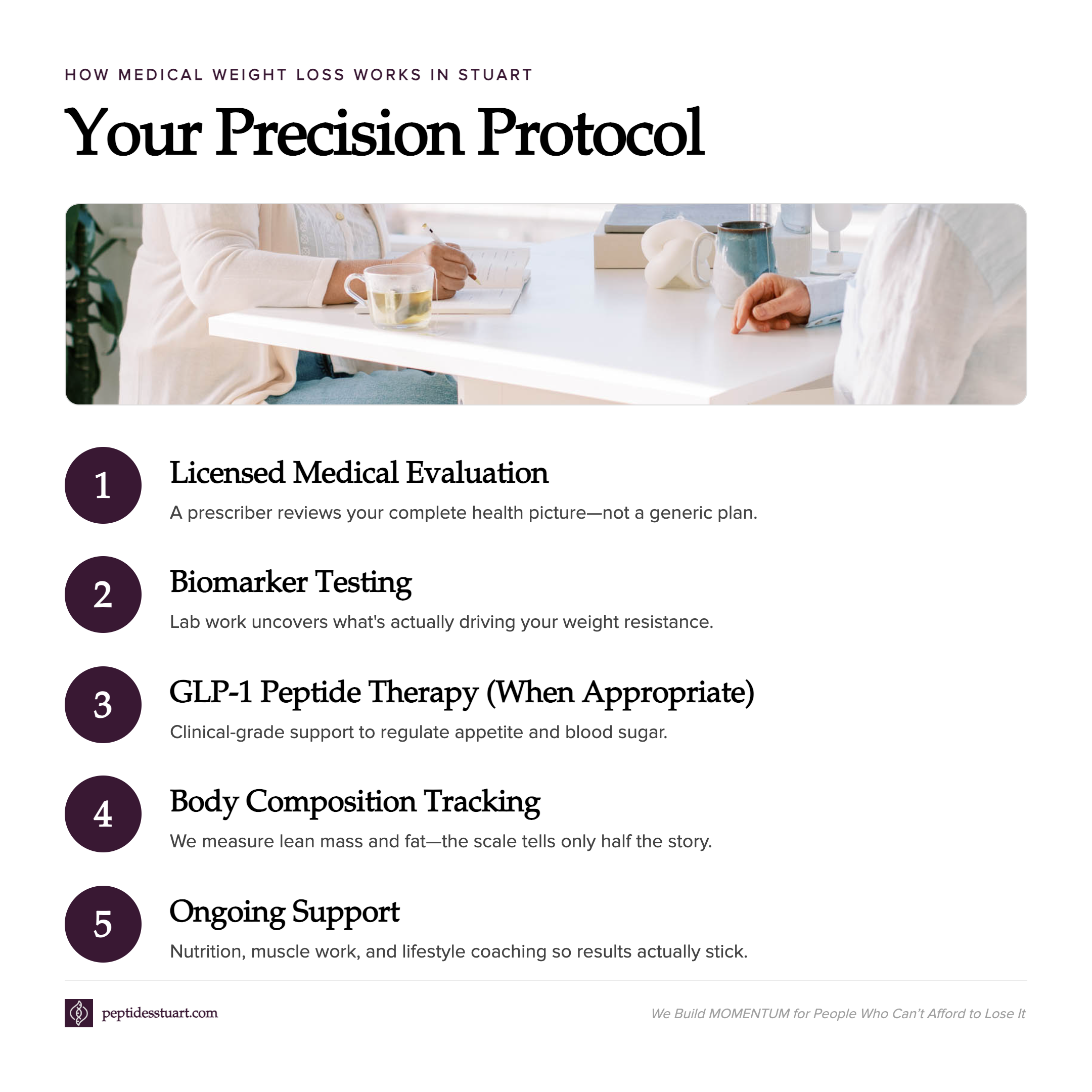
What Makes Momentum Different
While most clinics hand you a prescription and send you on your way, we stay in the trenches with you.
Our approach is systems-based and whole-person focused:
Your plan may include:
- Metabolic testing (glucose, insulin, inflammation)
- Hormone and thyroid panels
- Gut repair + nutrient absorption uncovering
- Body composition monitoring to protect muscle
- Precision dosing and slow titration of GLP-1 peptides
- Lifestyle strategy + behavior coaching
- Peptide stacks for repair, longevity, or performance (Tesamorelin, Ipamorelin, NAD+, BPC-157, etc.)
Because sustainable medical weight loss doesn’t just come from a shot—it’s built on clarity, support, and cellular repair.
Who This Is For
You may be ready for peptide therapy if…
- You’ve done “everything right” but still feel stuck
- You struggle with insulin resistance, PCOS, or prediabetes
- Your hunger feels disconnected from your nutrition
- You’re noticing weight gain during perimenopause or andropause
- You want to feel stable—not driven by cravings or exhaustion
- You believe your body is trying—but it needs better inputs, not more discipline
We restore the conversation between your body and your biology—so your metabolism listens.
Frequently Asked Questions About GLP-1
Why Does GLP-1 Therapy Work So Well for Weight Loss?
Because weight loss is not about willpower.
It’s about restoring metabolic communication at the cellular level.
Most individuals on GLP-1 peptides also experience improvements in:
- Cardiovascular markers
- HRV and autonomic stability
- Systemic inflammation
- Bone density
- Neuroprotection and lower cognitive decline risk
- Hormonal regulation and appetite predictability
These benefits are strongly supported in your patient guides for both women and men.
Who GLP-1 Therapy Is For?
You may be a great candidate if you want to:
- Reduce visceral fat or metabolic syndrome
- Improve insulin sensitivity
- Stabilize appetite and eliminate food noise
- Support perimenopause or andropause shifts
- Optimize blood sugar and cardiovascular markers
- Rebuild your relationship with food
- Shift from reactive eating to intuitive nourishment
- Reclaim energy and metabolic stability
We treat patients seeking fat loss, longevity, inflammation reduction, and metabolic repair—not just a smaller number.
How Do You Personalize a GLP-1 Protocol?
No two bodies metabolize, digest, or respond the same way.
Your protocol is built with:
- Metabolic testing to understand insulin patterns, inflammation, and nutrient utilization
- Body composition analysis to track fat loss and protect muscle (a major gap in most programs)
- Hormone and functional medicine testing to optimize thyroid, cortisol, and sex hormones
- Peptide stacking strategies when appropriate—such as adding Sermorelin, Tesamorelin/Ipamorelin, NAD+, or BPC-157/TB-500 for longevity, repair, or performance goals
These insights ensure your metabolism is supported—not stressed.
Our approach mirrors the synergy observed in longevity peptide research, where metabolic optimization plus tissue repair leads to greater vitality and resilience.
Can Peptides be Combined with GLP-1 Therapy?
Yes—many peptides pair beautifully with GLP-1s to support muscle preservation, energy, sleep, recovery, gut health, and overall metabolic repair. When used together under proper guidance, peptide stacks can strengthen the pathways that GLP-1s activate and round out your results.
Does GLP-1 Therapy Cause Muscle Loss?
You’ve heard the myths.
Here’s the truth:
GLP-1 peptides don’t cause muscle loss.
Undereating does.
Lack of protein, lack of movement, and lack of proper coaching does.
Your guide breaks this down clearly:
Muscle loss happens when weight loss occurs without:
- Adequate protein
- Strength-based movement
- Hormone balance
- Foundational metabolic support
- Coaching to guide dosage, habits, and behavior patterns
We correct all of that.
How Long Until I See Results?
Every metabolism responds differently, so results naturally vary. Some clients lose 1–2 pounds per week, while others need time, dose adjustments, or foundational support before the scale begins to move. Slow, steady loss is healthiest, and we encourage a minimum 90-day expectation for your body to recalibrate and begin responding fully.
Are GLP-1s Safe Long Term?
Yes—GLP-1s are generally safe for long-term use. Some people use them consistently, some cycle them, and others use them for short therapeutic windows depending on their metabolic needs. Whether used briefly or over longer periods, a minimum 90-day course is recommended to create meaningful metabolic improvement.
How Is Momentum Different?
Other clinics prescribe GLP-1s.
We build metabolic roadmaps.
Your care includes:
- Expert clinical dosing
- Slow, sustainable titration
- Full GLP-1 education + mindset coaching
- Functional, hormone, and metabolic testing
- Body composition monitoring
- Gut and cellular inflammation correction
- Long-term peptide protocol design
- Access to regenerative medicine stacks
- Structured movement + protein integration
- Emotional/behavioral food-pattern recalibration
- Concierge support for dosage, symptoms, and progress
This is whole-body optimization, not medication management.
Tumor Reduction & Anti-Inflammatory Effects (Breast Cancer / GLP-1 Biology)
1.1 Liraglutide & Breast Cancer Cell Proliferation (MCF-7, in vitro)
Zhao W, Zhang X, Zhou Z, et al. Liraglutide inhibits the proliferation and promotes the apoptosis of MCF-7 human breast cancer cells through downregulation of microRNA-27a expression. Molecular Medicine Reports. 2018;17(3):3627–3637.
DOI: 10.3892/mmr.2018.8475
URL: https://doi.org/10.3892/mmr.2018.8475 PMC
1.2 GLP-1RA Exendin-4 Attenuates Breast Cancer Growth (NF-κB pathway)
Iwaya C, Nomiyama T, Komatsu S, et al. Exendin-4, a glucagon-like peptide-1 receptor agonist, attenuates breast cancer growth by inhibiting NF-κB activation. Endocrinology. 2017;158(12):4218–4232.
DOI: 10.1210/en.2017-00461
URL: https://doi.org/10.1210/en.2017-00461 SpringerLink
1.3 Narrative Review: Obesity Therapies (Including GLP-1) and Cancer Biology
Cuttica CM, Briata IM, DeCensi A. Novel treatments for obesity: implications for cancer prevention and treatment.Nutrients. 2023;15(17):3737.
DOI: 10.3390/nu15173737
URL: https://doi.org/10.3390/nu15173737 MDPI
1.4 Overview: GLP-1 Agents & Breast Cancer Safety / Mechanisms
Parsons K, et al. The impact and safety of GLP-1 agents and breast cancer. Cancer Medicine. 2025; Online ahead of print.
DOI: 10.1002/cam4.70932
URL: https://doi.org/10.1002/cam4.70932 Wiley Online Library
GLP-1 Peptides & Alzheimer’s / Dementia Risk Reduction
3.1 Semaglutide & First-Time Alzheimer’s Diagnosis (Target Trial Emulation)
Wang W, Wang Q, Qi X, et al. Associations of semaglutide with first-time diagnosis of Alzheimer’s disease in patients with type 2 diabetes: target trial emulation using nationwide real-world data in the US. Alzheimer’s & Dementia. 2024; Online ahead of print.
DOI: 10.1002/alz.14313
URL (PubMed): https://pubmed.ncbi.nlm.nih.gov/39445596/ Alzheimer’s Journals+1
3.2 GLP-1RAs & Dementia Risk (Large Real-World Cohort)
Cheng H-W, et al. Impact of glucagon-like peptide-1 receptor agonists on the risk of dementia in people with type 2 diabetes: a nationwide cohort study. Journal of Diabetes Investigation. 2025; Online ahead of print.
URL (PMC full text): https://www.ncbi.nlm.nih.gov/pmc/articles/PMC12145076/ PMC
3.3 GLP-1RAs & Reduced Dementia Risk (Propensity-Matched Cohort, Mechanistic Discussion)
AbuAlrob MA, Itbaisha A, Abujwaid YK, et al. Exploring the neuroprotective role of GLP-1 agonists against Alzheimer’s disease: real-world evidence from a propensity-matched cohort. 2025; Open-access article.
PMCID: PMC12536097
URL: https://pmc.ncbi.nlm.nih.gov/articles/PMC12536097/ PMC+1
3.4 Commentary / Clinical Translation Summary
Anderer S. GLP-1 medications may lower dementia risk, research suggests. JAMA. 2025; Editorial / News Article.
URL: https://jamanetwork.com/journals/jama/fullarticle/2833663 JAMA Network
Triple-Agonist Peptides (Retatrutide / GLP1-T Analogs)
2.1 Phase 2 Obesity Trial (Weight Loss, Metabolic Effects)
Jastreboff AM, Aronne LJ, Ahmad NN, et al. Triple–hormone-receptor agonist retatrutide for obesity — A phase 2 trial. New England Journal of Medicine. 2023;389(24):2219–2230.
DOI: 10.1056/NEJMoa2301972
URL (PubMed): https://pubmed.ncbi.nlm.nih.gov/37366315/ PubMed
2.2 Retatrutide & Liver Fat / MASLD (Visceral & Hepatic Metabolic Effects)
Sanyal AJ, Newsome PN, Garcia-Tsao G, et al. Triple hormone receptor agonist retatrutide for metabolic dysfunction–associated steatotic liver disease. Nature Medicine. 2024;30(8):2129–2138.
DOI: 10.1038/s41591-024-03018-2
URL (PubMed): https://pubmed.ncbi.nlm.nih.gov/38858523/ Nature+1
Book With Momentum
Bookings are by Appointment Only: Monday through Saturday
Momentum Integrative Wellness by Bella Rose
2440 SE Federal Highway, Suite 600
Stuart, FL 34994
Call Us 772-210-4799
The information provided on this website is for educational purposes only and does not constitute medical advice. Medical services are provided by licensed healthcare professionals following appropriate clinical evaluation.