If a single number on a bathroom scale has the power to ruin your morning, derail your week, or convince you that nothing is working — you are not alone, and you are not broken. You are simply trusting the wrong metric. The truth is, body composition matters far more than body weight, and once you understand why, the entire conversation about midlife health changes. This post breaks down what the scale actually measures, what it cannot see, and how a precision approach to body composition gives women in their 40s, 50s, and beyond a clearer, kinder, and more accurate picture of real transformation.
Table of Contents
What the Scale Actually Measures (And Why It’s Misleading You)
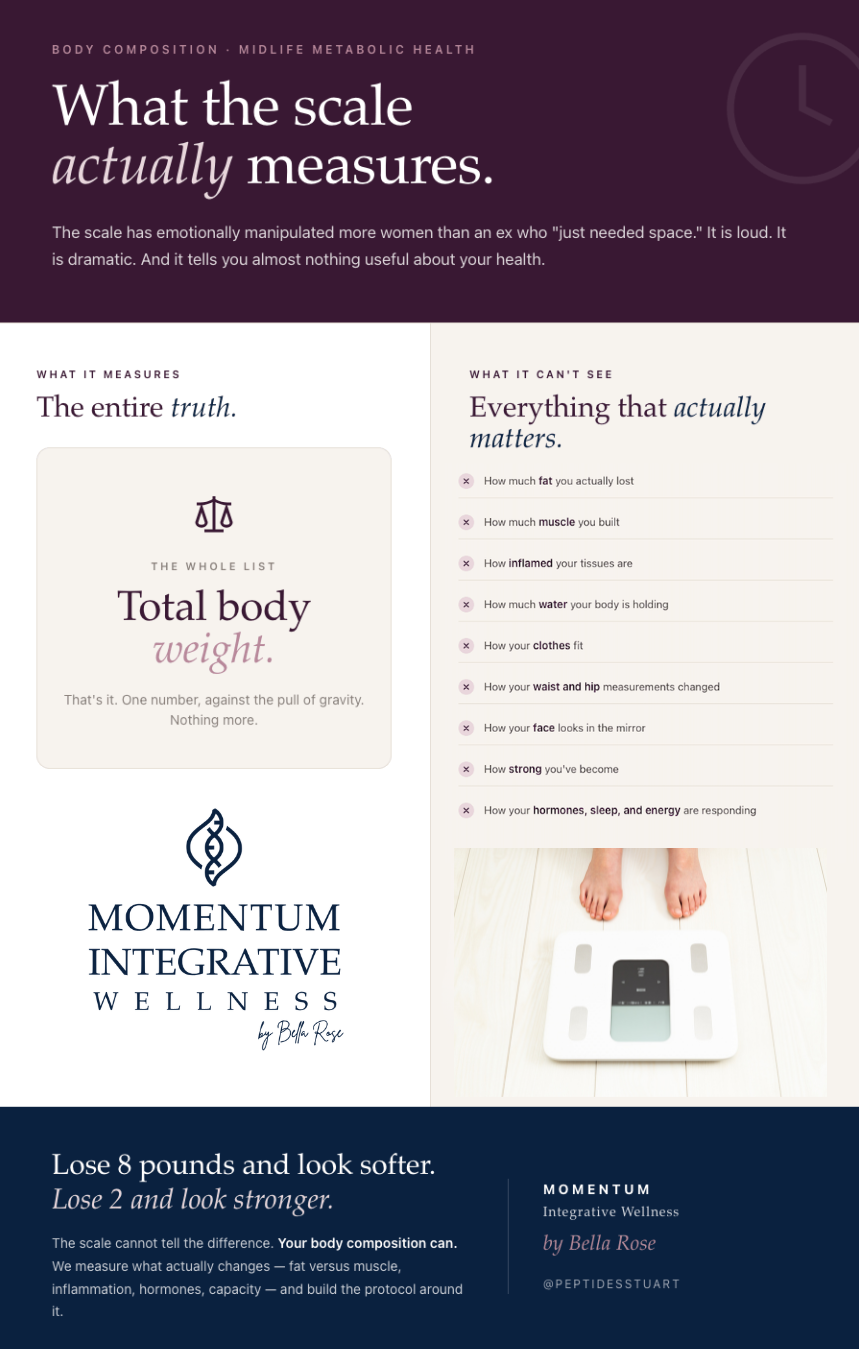
The scale has emotionally manipulated more women than an ex who “just needed space.” It is loud. It is dramatic. And it tells you almost nothing useful about your health.
Here is the entire truth of what a scale measures:
- Total body weight. That is it.
Here is everything it does not measure:
- How much fat you lost
- How much muscle you built
- How inflamed your tissues are
- How much water your body is holding
- How your clothes fit
- How your waist and hip measurements changed
- How your face looks in the mirror
- How strong you have become
- How your hormones, sleep, and energy are responding
So yes — you can lose 8 pounds and look softer, weaker, and more depleted. And you can lose 2 pounds and look tighter, leaner, stronger, and more athletic. The scale cannot tell the difference. Your body composition can.
Body Composition vs Body Weight: A Tale of Two Women
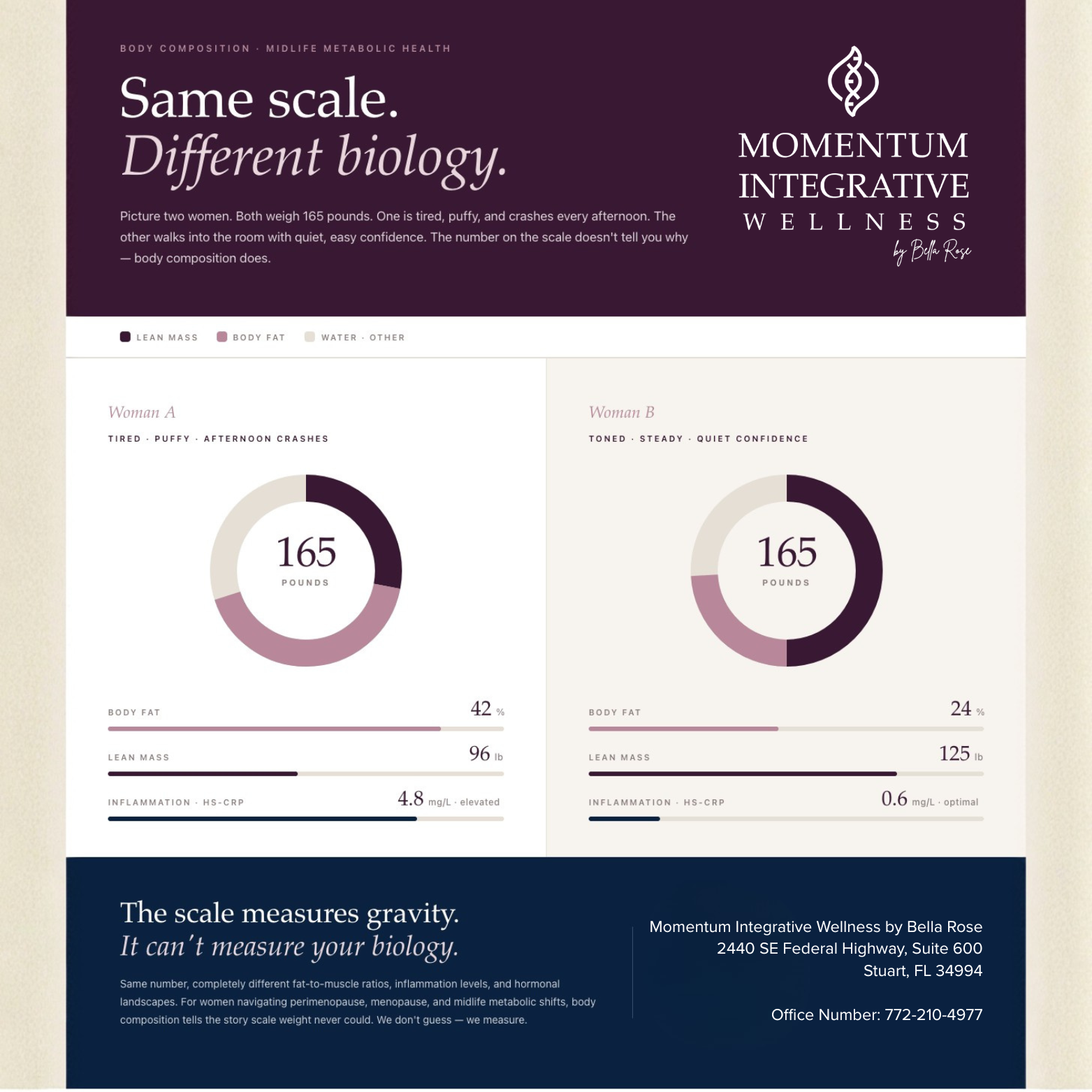
Picture two women. Both weigh 165 pounds. One looks tired, puffy, and battles low energy every afternoon. The other looks fit, toned, and walks into the room with quiet, easy confidence.
Same number on the scale. Completely different biology. Different fat-to-muscle ratios. Different inflammation levels. Different hormonal landscapes. Different metabolic health. This is the entire reason scale weight is a poor proxy for wellness — especially for women navigating perimenopause, menopause, and midlife metabolic shifts.
Why Midlife Changes the Math
After 40, hormonal shifts, insulin resistance, chronic stress, and gradual muscle loss change how your body responds to food, exercise, and sleep. The same routine that kept you lean at 32 may now produce inflammation, fatigue, and stubborn fat — particularly around the midsection. According to the National Institutes of Health, lean muscle mass naturally declines beginning in the third decade of life and accelerates after 50, which directly impacts metabolism, body composition, and long-term health. This is why protecting muscle is one of the most powerful — and most overlooked — strategies for midlife transformation.
The Self-Sabotage Cycle Most Women Get Stuck In
When the scale becomes the only goal, the strategy follows. Most women fall into a predictable, exhausting loop:
- Slash calories aggressively
- Skip protein at breakfast and lunch
- Avoid strength training because of “bulk” myths
- Obsess over the number every single morning
- Celebrate any drop, even when it is water and muscle
Then the energy crashes. The hair thins. The face looks tired. The waist stays the same. And the scale eventually plateaus, because the body is now under-fueled, under-recovered, and under-supported. That is not transformation. That is self-sabotage with a digital readout.
What We Actually Measure at Momentum
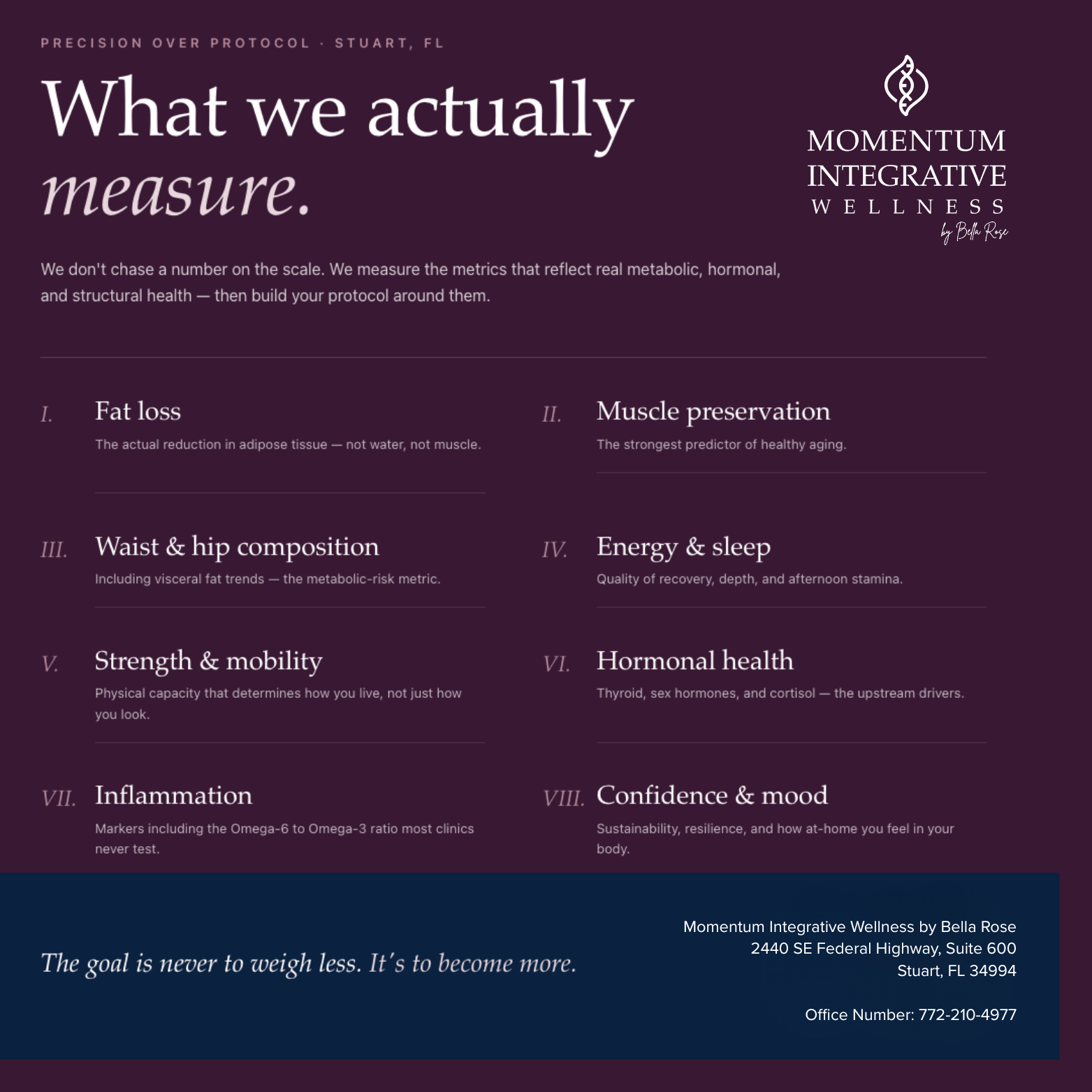
At Momentum Integrative Wellness in Stuart, FL, we believe in precision over protocol. Instead of chasing a number, we measure the metrics that reflect real metabolic, hormonal, and structural health:
- Fat loss — the actual reduction in adipose tissue
- Muscle preservation — the strongest predictor of healthy aging
- Waist and hip composition — including visceral fat trends
- Energy and sleep quality
- Strength, mobility, and physical capacity
- Hormonal health — including thyroid, sex hormones, and cortisol
- Inflammation markers, including the Omega-6 to Omega-3 ratio
- Confidence, mood, and long-term sustainability
When we layer in tools like personalized GLP-1 peptide therapy, hormone optimization, gut and brain support, and targeted regenerative protocols, the goal is never to make you weigh less. The goal is to help you become more — more energized, more capable, more resilient, and more at home in your body. You can learn more about our approach on our medical weight loss page, which outlines how we build a body composition strategy around your biology.
How to Track Real Progress (Without Worshiping the Scale)
If you want to know whether your plan is actually working, stop weighing yourself daily and start tracking the signals your body sends. Here is a more honest checklist:
- Body composition scan trends — fat mass down, lean mass steady or up
- Waist measurement at the navel, taken monthly
- Progress photos in the same lighting every two to four weeks
- How clothes fit, especially waistbands and shoulders
- Resting energy throughout the day — particularly the 3 p.m. window
- Sleep quality and recovery
- Strength benchmarks — how much weight you can move with control
- Mood, confidence, and how you feel walking into a room
These markers reflect what is happening underneath the surface — the actual remodeling of your metabolism, muscle, and hormones. They are slower, quieter, and infinitely more honest than a scale that swings four pounds because you ate sushi the night before.
Frequently Asked Questions About Body Composition
Q: What is body composition and why does it matter more than weight?
A: Body composition refers to the ratio of fat, muscle, water, and other tissues that make up your total weight. It matters more than weight because two people at the same number on the scale can have completely different health profiles — different fat percentages, muscle mass, inflammation, and metabolic resilience. Improving body composition is what changes how you look, feel, and age.
Q: How do I improve my body composition after 40?
A: Focus on preserving and building lean muscle, supporting hormonal health, reducing inflammation, prioritizing protein, and using clinically guided tools when appropriate. At Momentum, that often includes hormone optimization, individualized GLP-1 peptide therapy when indicated, gut and metabolic support, and a long-term plan that protects muscle while reducing fat.
Q: Is the scale ever useful?
A: Yes — but only as one data point among many, and only when tracked over weeks, not days. Daily weigh-ins reflect water, salt, hormones, and digestion more than fat. Most clients do better tracking weight weekly or monthly, alongside body composition, measurements, and how they feel.
Q: How does Momentum measure body composition?
A: We use advanced body composition analysis to track lean mass, fat mass, and key metabolic indicators over time. Combined with biomarker testing and a thorough clinical evaluation, this gives us a true picture of what is changing in your body — not just on a scale.
Stop Chasing a Number. Start Optimizing a Life.
If the scale ruined your mood this morning, the scale is the problem — not you. Your body is not failing you. It is asking for a more accurate map. Body composition gives you that map. It separates fat from muscle, signal from noise, and short-term water swings from real, durable change. It honors the truth that midlife is not the beginning of the slowdown — it is the moment your body is ready for precision.
If you are ready to stop weighing yourself into a worse mood and start measuring what actually matters, we are here. Call 772.210.4977, message us at @PeptidesStuart, or book your consultation at PeptidesStuart.com. By appointment only — Monday through Saturday. You deserve more than guesswork.