
You’re doing the work — training, eating well, trying to sleep — but the energy, drive, recovery, and focus you used to count on just aren’t there. You finally bring it up to a doctor, and you’re told your bloodwork is “normal.” If that’s you, this is worth reading. Hormone optimization for men isn’t about chasing a number on a lab sheet. It’s about whether you actually feel like yourself. At Momentum Integrative Wellness in Stuart, FL, we test, we measure, and we don’t guess.
This isn’t about turning back the clock overnight. It’s about giving your biology the precise support it’s been missing.
Table of Contents
“Normal” Labs Don’t Always Mean Optimal
Here’s the gap most men run into: standard lab ranges are wide, and they were built around population averages — not around how you feel or function. A testosterone level near the bottom of the range can be flagged “normal” while you’re living with fatigue, low motivation, poor recovery, brain fog, and a libido that’s quietly disappeared.
Symptoms matter. When a man in his 40s, 50s, or beyond describes that cluster — low energy, stalled progress in the gym, irritability, thinning drive — that’s a physiology conversation, not a willpower one. Normal for a lab range isn’t the same as optimal for you.
The Science Behind Hormone Optimization for Men
Testosterone influences far more than libido. It plays a role in muscle mass, fat distribution, bone density, mood, cognition, energy, and motivation. Levels naturally decline with age, and that decline is accelerated by stress, poor sleep, metabolic dysfunction, and inflammation.
The good news: the clinical conversation around treating it has shifted significantly. In February 2025, the FDA updated class-wide testosterone labeling after the large TRAVERSE trial found no increased risk of major cardiac events in appropriately selected men — a meaningful change from the older, more restrictive guidance. You can read more about the role of testosterone and the symptoms of low testosterone from the Cleveland Clinic. The takeaway for symptomatic men is simple: optimization is back on the table as a serious, evidence-informed option — when it’s done with proper evaluation and monitoring.
Test, Don’t Guess: How Momentum Approaches Men’s Hormones
The opposite of optimization is guesswork — grabbing gray-market product online, copying a friend’s protocol, or accepting “you’re fine” when you know you’re not. Both extremes skip the one thing that actually matters: your individual data.
At Momentum, every man is evaluated by a licensed medical prescriber. We look at the full picture, monitor biomarkers, and build an individualized plan — then we track it over time and adjust. This is not DIY medicine. It’s thoughtful, medically supported care for the season of life you’re in.
What a Personalized Plan May Include
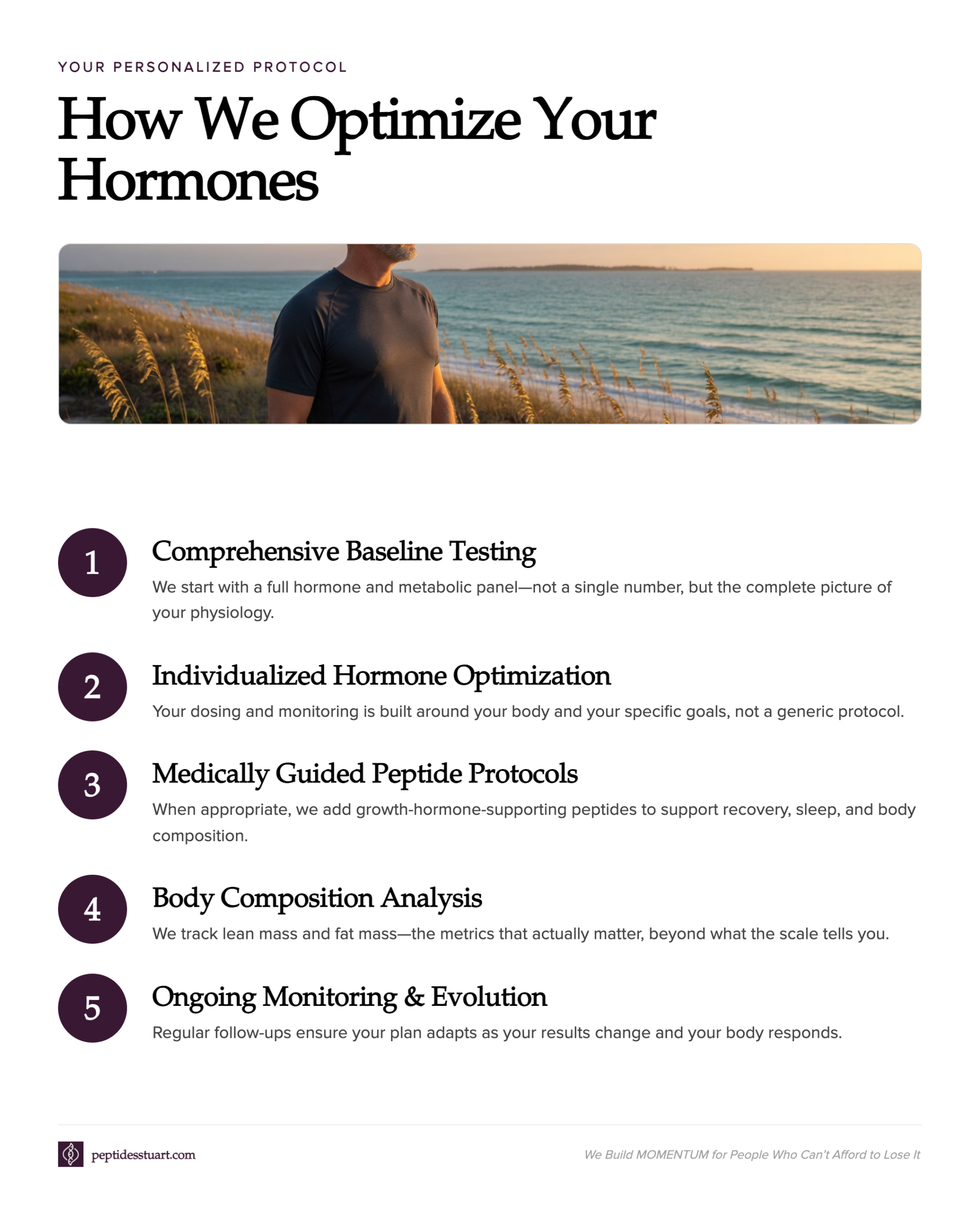
- Comprehensive baseline testing — a full hormone and metabolic panel, not a single number.
- Individualized hormone optimization — dosed and monitored to your physiology and goals.
- Medically guided peptide protocols — options such as growth-hormone-supporting peptides for recovery, sleep, and body composition where appropriate.
- Body composition analysis — tracking lean mass and fat mass, because the scale alone misses what matters.
- Ongoing monitoring — regular follow-up so your plan evolves with your results.
You’re not guessing anymore. You’re optimizing.
It’s Not Just a Women’s Conversation
Hormone care has, for years, been framed almost entirely around women in midlife — and that work matters deeply. If that’s where you are, our honest guide to hormone replacement therapy for women speaks directly to it. But men go through their own gradual hormonal shift, and they’re far more likely to be told to simply “tough it out.”
Energy, recovery, mood, focus, and drive are not luxuries. They’re how you show up for your work, your training, and the people who depend on you. For active men 40 and up, hormone optimization is a core piece of longevity — aging with intention instead of just accepting the slide.
[IMAGE: hormone optimization for men consultation in Stuart FL]
Your Body Has Been Waiting for the Right Support
If you’ve been dismissed, told your labs are “normal,” or handed a one-size-fits-all answer, you deserve more than guesswork. Hormone optimization for men, done right, starts with real data and a provider who treats you like a person, not a panel. We measure, we optimize, and we walk with you every step of the way. Your body hasn’t forgotten how to feel strong — it’s been waiting for the right support.
📞 Call 772.210.4977 or visit PeptidesStuart.com to book your consultation in Stuart, FL. By appointment only, Monday through Saturday.
Frequently Asked Questions About Hormone Optimization for Men
Q: What is hormone optimization for men?
A: It’s a medically guided approach to evaluating and supporting a man’s hormone levels — primarily testosterone, along with related markers — based on symptoms and comprehensive testing, not just a single lab value. The goal is to help you function and feel your best, with monitoring along the way.
Q: My doctor said my testosterone is “normal.” Why do I still feel off?
A: Standard lab ranges are broad and based on population averages. A level near the bottom can be labeled normal while you experience fatigue, low drive, poor recovery, and brain fog. Optimization looks at your symptoms and your full panel together — because normal for a range isn’t the same as optimal for you.
Q: Is testosterone therapy safe?
A: For appropriately selected and monitored men, the evidence has become more reassuring — the FDA updated testosterone labeling in 2025 after large trial data found no increased major cardiac risk in properly selected patients. Safety depends on proper evaluation, individualized dosing, and ongoing monitoring by a licensed provider.
Q: Do you offer men’s hormone optimization in Stuart, FL?
A: Yes. Momentum Integrative Wellness provides medically guided, individualized hormone optimization for men in Stuart, FL, including comprehensive testing, personalized protocols, and ongoing monitoring.
Medical services are provided by licensed healthcare professionals following appropriate clinical evaluation. This article is educational and is not medical advice. Individual results may vary.